Pentagon officials are talking about expanding the fight against Islamic State group extremists in Iraq and Syria, several top officials said.
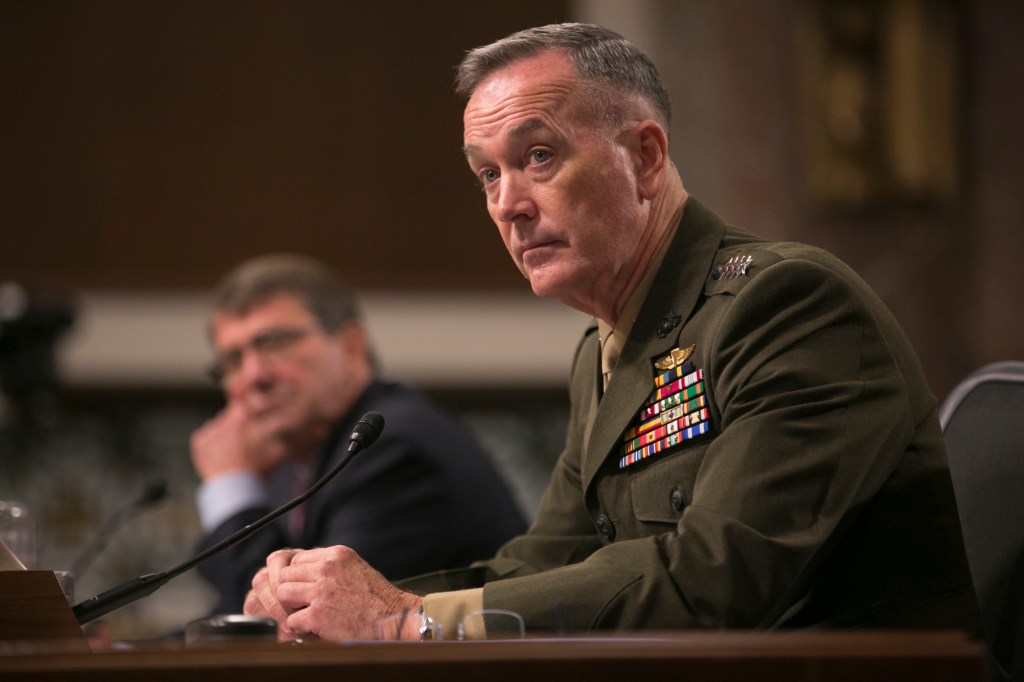
The U.S. military is “adapting our campaign to do more, reinforcing what we know works,” Defense Secretary Ash Carter told lawmakers at a Tuesday hearing of the Senate Armed Services Committee.
The military’s highest-ranking officer, Marine Corps Gen. Joseph F. Dunford, testifying alongside Carter, mentioned high-level discussions about sending more U.S. troops to be “co-located with Iraqi units.”
“The secretary and the president have made it clear that they expect me to bring to them all of the options that may contribute to our winning the fight against” the Islamic State, said Dunford, chairman of the Joint Chiefs.
Dunford said the goal of an expanded mission in Iraq would have a few elements: “situational awareness intelligence,” to encourage Sunni-Shiite cooperation, and to improve the effectiveness of both U.S. logistical support and delivery of combined arms.
“That would be the basic framework within which I’d make a recommendation for additional forces to be co-located with Iraqi units,” he said.
About 3,500 American troops are now in Iraq, many of them involved in the training and support of Iraqi military units. U.S. advisers are mostly at the division or headquarters level; evolving plans could push more U.S. advisers down to the brigade level, while also possibly putting a small number of special operations forces on the ground in Syria, according to a Washington Post report Tuesday.
The Pentagon has forwarded to President Obama several options for altering or expanding the mission in Iraq and Syria, according to the Post. No U.S. troops are currently regularly deployed to Syria.
Meanwhile, the Pentagon has quietly expanded its force of civilian contractors in Iraq to more than 1,400, up from about 250 in January, according to newly released Pentagon data. That force includes over 400 maintenance contractors and more than 300 translators.
Carter signaled that the U.S. may expand use of special operations forces, like the Oct. 22 raid involving dozens of U.S. soldiers that resulted in the first combat death in Iraq since 2011. Army Master Sgt. Joshua Wheeler was shot in a firefight with Islamic State group militants while supporting Kurdish peshmerga troops in a rescue operation at a prison facility south of Kirkuk, and later died of his wounds.
“We won’t hold back from supporting capable partners in opportunistic attacks against ISIL or conducting such missions directly, whether by strikes from the air or direct action on the ground,” Carter said, referring to the Islamic State group by an alternative acronym.
He said the overarching policy of keeping U.S. troops out of direct combat will not prevent putting teams of special operations forces on the ground alongside allied forces.
“Our mission in Iraq is to train, advise and assist our Iraqi partners in situations such as that operation,” Carter said, referring to the Oct. 22 raid.
He also said the U.S. and its coalition partners will be ramping up airstrikes in Syria, which have slowed during the past several weeks. The focus of that effort will be Raqqa, the Islamic State’s stronghold in Syria.
“We expect to intensify our air campaign, including the additional U.S. and coalition aircraft to target ISIL with a higher and heavier rate of strikes,” Carter said. “This will include more strikes against ISIL high-value targets as our intelligence improves.”
He said that, at the moment, the Pentagon has no interest in an aggressive effort to remove Russian and Syrian aircraft from Syrian airspace.
“We do not have a concept of operations for a no-fly zone at this time,” Carter said.
A White House spokesman downplayed the changes taking place and said that they do not reflect any fundamental shift in U.S. strategy.
“This isn’t an example of mission creep as much as it is an example of the administration taking a look at our strategy and trying to capitalize on those elements of the strategy that have been particularly successful,” spokesman Josh Earnest said Monday.
Expanding the U.S. mission in Iraq was an idea floated in August by outgoing Army Chief of Staff Gen. Raymond T. Odierno.
“If we find in the next several months that we aren’t making progress, we should absolutely consider embedding some soldiers (in Iraq),” Odierno told reporters Aug. 12, adding that this was an “option we should present to the president.”